Wednesday, July 17, 2013

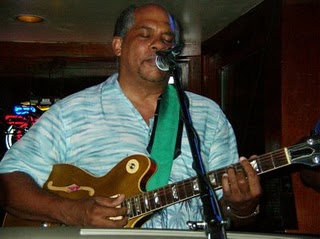
More About Eric "Two Scoops" Moore (The Interview!)

Something about piano players- they all seem to be good writers, too.  On my other website, goheadon, you can find wonderful "interviews" of Robert LohrDaryl Davis and Robert Baldori.  Since these interviews are done by e-mail, it takes a bit of commitment on the other side.  (Davis, an author, sent 12 single spaced pages!)  Well, here we go again, with Eric "Two Scoops" Moore: boogie-woogie and blues pianist, sideman, poet, songwriter, dishwasher, housepainter and husband.  The husband and storyteller parts are merged perfectly, since each story leads back to wife Amy.  But on the way you'll learn about blues, food and geography, and time spent hanging with people like Pinetop, Buddy, Luther, and "Earring" George.


How long have you been in Seattle?  How'd you wind up here?

In 1995 I was playing with Luther on the 3rd annual Ultimate Rhythm And Blues Cruise.
I spotted a hot little blues mama that seemed to be having more fun than everyone else.

Later I saw her standing behind a table with Washington Blues Society literature, (this week-long cruise was the 1st week in a 12 week tour that went from Boston to Florida to  Dallas  up to Tulsa back down to Houston then to Phoenix  LA, San Diego, Santa Cruz, Seattle, Vancouver, Edmonton Red Deer, Calgary, Ketchum, Idaho, Denver, Vail, Soiux Falls, Kansas City, Lincoln, Chicago, Dearborn, Buffalo and back to Boston.)

I told Amy I would be in Seattle in a few weeks and she gave me her phone number. When I got to  Seattle I called her from the Backstage and she drove from West Seattle   to Ballard to see me.  Now, on the cruise I couldn’t seem to pry  her away from dancing with Taj Mahal  long enough to notice me, but there at the Backstage on February 14,  I asked her if she had a Valentine and she said no, so I kissed her.

Exactly a year later on February 14, 1996, we were married at the original House of Blues in Cambridge, Massachusetts. Within a year I quit Luther’s band and moved to Seattle.

That is how I got to Seattle.

Where did you grow up?  And how did you get into boogie-woogie and blues?  How did you learn to play?

They tell me that when I was a baby I used to wave my arms like I was conducting when music played. It probably started when I was watching Lawrence Welk or Mitch Miller on TV.  My earliest memory is singing “Lazybones” and “Witch Doctor ”oo ee oo ahh ahh ting tang walla walla bing bang”.  Those songs were in my older sister’s 45 collection. She took piano lessons and I usually figured out by ear what she was practicing.  By the time I took piano lessons, it was impossible to teach me to read music because I could already play by ear or at least I thought I could. I couldn’t play anything right of course because I had to make up the ending which always sounded right to me, but the teacher could tell that I wasn’t reading. I never practiced but I always played. It didn’t look good for a successful music career.  It still doesn’t, but I’m still playing!


One thing that’s good about playing your own songs is that they can’t tell if you’re playing them wrong. There’s nothing like making up a song while playing it and that’s what the blues is all about. In my 1st piano lesson the old witch explained  that the strings are  like human voices that can hear each other and resonate with sympathetic vibrations.  I discovered the damper pedal; it turned the piano into an organ. It felt like I had a heavenly choir at my fingertips.

Tell us a little about your days touring with other blues artists.

I’ve been the low man on a lot of totem poles:

I was a dishwasher who wanted to flip hamburgers.

I was a land surveyor but I only held the “dumb end” of the tape. I had to hold the 0 end over a point in the ground with my thumb through a metal loop, while the smart guy pulled as hard as he could to accurately measure the distance. I always had a sore thumb, but at least I didn’t have to deal with any numbers. Finally, I refused to enter a patch of poison ivy and lost that job. I never did get to look through the transit.

I got a job for a painting contractor; I couldn’t paint at first, but I could carry and set up a 40-foot ladder by myself. They sent me up to paint the third-floor windows with a caulking gun, a putty knife and a can of paint and said, “Don’t come down until the windows are done and if you fall off the ladder, you’re fired before you hit the ground.” After working there for a few years, I wanted a raise from $6 an hour to $8.  They offered me $7 so I quit. Someone had offered me $3,000 to paint a great big house on my own ladder. From then on, I was painting on my own. 

In the meantime, I was spending all the money I was making running around with “Earring” George. He was a high maintenance bluesman.  Every night I would buy him a pack of Newports, a pint of Seagram’s gin and a lottery ticket. We would go around from club to club.  Any time a major blues star was in town, George just had to show his face and we would end up sitting in. They were so happy to see that he was still alive! I’m talking about people like Buddy Guy, James Cotton, KoKo Taylor, and Zora Young. (George used to drive Zora Young to the blues jams in Chicago when she was a kid.) One time we were sitting backstage with Buddy Guy, Pinetop Perkins, and Big Daddy Kinsey. Some clown walks in and starts to tell George to leave. Pinetop Perkins leapt out of his seat and yelled, “That’s Earring George!” I won’t say who the clown was, but he knows who he is.

One person who puts up with no disrespect is Luther “Guitar Junior” Johnson. It’s a joy to watch him put arrogance in its place. One time in Belgium, they tried to put us up in the middle of nowhere on the outskirts of the city. When Luther saw the rooms, which were more like cells, he cursed a blue streak and threw the room keys down on the sidewalk at the feet of the promoter and said, “Take me to a hotel downtown where I can get something to eat or take me back to the airport.”  We were immediately whisked to a hotel downtown.  Working for Luther “Guitar Junior” Johnson was an ear-opening experience.

One time, we landed in Morocco a day early and there was no one at the airport to greet us. But there were lots of guys with machine guns standing around with their fingers on the triggers.  We checked into the Holiday Inn Crowne Plaza in downtown Casablanca. We all had to sign for our rooms; I was worried that I would have to pay for it myself. Luther said, “Don’t worry, they’ll pay.” They paid! That night “Sax” Gordon and I were exploring the Casbah and some guy kept bumping into Gordon saying, “American hi-karate.”  We kept walking and Gordon noticed that his passport was gone from his jacket pocket. We immediately grabbed the guy and started frisking him like two cops would, looking for the passport. I was afraid to let his hands go for fear that he would produce a knife. Just then 4 or 5 of his friends came running up to us saying, “You dropped these.” They were holding up Gordon’s passport and room key card. They gave us back the passport and the key and we gave them back their friend.  He had been pulling things out of Gordon’s jacket and dropping them on the sidewalk as his friends followed.  

Luther is like a brother to me. It always cracked him up when I would say, “This is the best food I’ve ever had!” whenever it was free.  But the food was usually really good – they treated us like Kings most places we went. In Paris, we played the Lionel Hampton Jazz Club in Le Meriden hotel, for a two week stay. We could get half-price in the hotel restaurant but even half-price was too expensive. We would have had to pay $30 to eat at the $60 buffet. 

Finding affordable food in Paris is difficult. I went to an outdoor market and saw three chickens; one was Fr.55 one was Fr.45 and one was Fr.15. The two expensive ones looked identical. I asked what the difference was and the Frenchman said, “The expensive one is better.”  The one that was Fr.15 was the scrawniest little chicken I ever saw, but it was the right price. The sign above it said “Couquette.”  I thought to myself, “Hmm, this must be the kind that they make chicken croquettes out of.”  It tasted kind of funny, so I gave the other half to the drummer. He thought it tasted funny too. The next day, I walked back to the market and I saw the other side of the sign. It said “Pidgeon.”  I finally broke down and bought myself a meal in the hotel restaurant. I ordered beef stew. It was the only beef stew I ever had with skin and fur still on the meat.  Even a quarter pounder with cheese cost $5.  My favorite meal in Paris was a head of frisse’ lettuce in an ice bucket with oil and vinegar and a loaf of French bread.

They sure are crazy about the blues in Europe. Luther always had me sing a couple of songs to open the show. Just imagine 10,000 drunk Belgians all yelling, “Big Fat Mama!”  It was a sight to enthrall.  Well, for a guy who normally made his money on a ladder, being on the international blues circuit was like 6th Heaven.  But then I met Amy and I ascended the 7th rung. I must admit, I was sleep deprived and in mourning for “Earring” George when I was pierced by Cupid’s sharpest arrow. I continued working for Luther for another year, but Amy had gotten me a 1-800 telephone number to call her on.  I had seen it happen to guys before and even been warned by Henry that “Women tell you they love you to play the blues, but the minute you get with them, they don’t want you to go nowhere!” he used to say.  But it was too late. I was infected and now I live in blissful isolation.  All I want to do is be close enough to smell her all the time. I don’t play my piano for anyone but her unless she compels me. 


(Editor's note: Eric should be back at Luso Food and Wine on August 3 (check with Luso's for details).  Meanwhile, here's a LINK to videos that include Amy & Eric's wedding, a great performance with Luther "Guitar Jr." Johnson, and Moore's performance to a giant crowd at the 1999 Bumpershoot festival.  And  as an added bonus, below, Johnson in the 1990s with  in Europe with another pretty good band.)


Saturday, July 13, 2013

Eric "Two Scoops" Moore at Luso Food and Wine


I'm always the last to know.  But I don't mind as long as I find out eventually. 

And last night, at a little place in White Center, I found out again.  

Hooray!

Last night my wife and I had a chance to go out.  She knew a spot for dinner.  I searched the music listings for something interesting.  I wasn’t sure I’d found it, but we decided to take a chance on Eric “Two Scoops” Moore at a place called Luso Food and Wine in White Center.  We’d never heard of the person or the place, but the music calendar promised boogie-woogie and blues, and Yelp gave the place five stars for food, wine and community.  Plus, there was something about “Two Scoops” having won a Washington Blues Society award for songwriting, so I figured this was the real thing.

Then I checked youtube and found THIS!


Check out some of the lyrics for Big Buffet!

They got meat and potatoes
They got beans and rice they got
Real country gravy
Make you go back twice 
They got bacon, baloney
Salami and ham
Liverwurst and knockwurst and
“Move along, ma’am!”

And it keeps going, with food after food and rhyme after surprising rhyme.  For a guy who grew up on Chuck Berry lyrics this is too good, and it may be the best food song since Louis Jordan’s Beans and Cornbread.  Except that Moore has also written songs with names like Hamburger Time, Let’s Eat and Pork Chops.  

Luso Food and Wine (read about it HERE) is on a street in White Center that reminds me of some streets I visited in The Bronx recently, except that those were teaming with people and 16th Street SW was practically empty last night, and so was was Luso, at least at the beginning.  The place itself is large and bright.  There are wines and beer and specialty foods from Brazil, Portugal and India.  The owner, Tina, is a Portuguese citizen of Goan heritage.  “Two Scoops” was at an old Yamaha electric piano wearing a straw fedora and green sport coat that was practically florescent.  And pretty much as soon as we sat down he launched into Big Buffet!  After that it didn’t stop for more than an hour.  He sang son after song from his compilation album “Big Buffet Combo Platter” (there was one copy on the counter, and I bought it): songs like Two Scoops, He Quit, Stop Shopping Mama, Lefthanded, Clean Clean Clean and Hamburger Time.  There was no microphone, so I had to lean in and wait for punch lines to hear bits of the lyrics, but the punch lines kept coming.  Meanwhile “Two Scoops” keeps things rolling with his piano licks, doing all the riffs I now hear horns doing on his record, pounding out bass lines with his left.  The songs aren't all about food.  They cover the gamut of everyday life: a woman who cleans too much ("she's stronger than dirt!"); another who shops too much ("I don't want to die in a department store!"); another who's big and fat; a song about car trouble that has made it to Car Talk; a song about quitting cigarettes; one about whiskey; a song about being "good for nothing," and one about "two left hands."  And a powerful love song called "place of love."  ("You can make a lot of money, but you'll never have enough.  Don't let nothing take the place of love.")

The record turns out to be one of several Moore has put out since 1997.  It's a "greatest hits" record.  The sound on each cut is rich and full, with horns and drums, and a voice that sounds a little like Dr. John meets Randy Newman.  Since it's a compilation about 20 musicians participated, including blues guitar legend Duke Robillard, who produced one of the albums and provides a testament on the back of this one, saying “As all great Blues artists are, Eric is a storyteller whose slant on life gives his music a wonderful twist full of humor, optimism and love.”

The fact that Robillard says this shows that just because I've missed out on Moore until now, the rest of the world hasn't.  According to Moore's website "Moore toured and recorded with the late Chicago blues harpmaster, "Earring" George Mayweather (7 years) and the great Muddy Waters guitarist, Grammy and Handy award winner, Luther "Guitar Jr." Johnson (6 years). Two Scoops has performed his brand of boogie magic at premier blues venues and festivals in 36 states, 12 countries on three continents."

In addition to making music, Moore makes sculpture and paintings.  Check a bit of it out below, or on his Facebook page.


Before the show was over other folks had wandered in to listen and grin.  One was a young hispanic kid named Daniel.  I thought it was just a random encounter until he begged Moore to play and sing one more, then joined him at the keyboard to play along to Moore's left hand.  Maybe it was a random encounter, but I suspect there will be more of them.

Eric “Two Scoops” Moore will be playing at Madison Park in Seattle with his combo on August 8 from 6:30 to 8:00 pm.  More about that on his website, http://www.twoscoopscombo.com/.  And Luso Food and Wine owner Fatima hopes to make him a regular feature on Fridays or Saturdays.  I’ll be there if she does.  You, too.

(Eric is tentatively scheduled to play at Luso's on August 3.  Check with Luso's for details.)

Friday, May 25, 2012

Big Bang Theory

Several of my all time favorite songs have a common denominator: a big bang climax.  An obvious example is Otis Redding singing "Try a Little Tenderness," when words finally aren't enough and Otis spits out those wonderful sounds and syllables.  You know the moment, but just in case, it's at 3:08.


But maybe you don't know "Stand!" by Sly and the Family Stone.  I first heard this pretty much the same week that I first heard "Try a Little Tenderness."  My brother Paul left both records in my room, and I played them a lot.  The payoff comes at 2:17 when the third chorus of "Stand!" turns into a thudding bass riff that dominates the rest of the song.


As I got older I found jazz.  Duke Ellington's "Take the A Train" has a beautiful moment when several horns come in one after the other to create a chord.  It happens at 2:15.


And then T-Bone Walker, and his instrumental "Goin' to Funky Town."  Everything about his guitar on this one blows my mind, but my head pops off at about 4:40.


Tuesday, December 6, 2011

Kids

You gotta love kids, and they can turn out to be anyone!

Chuck Berry as a kid

Fats Domino as a kid

Sunday, December 4, 2011

RIP Hubert Sumlin


Alas, just got the news.  Here's my account of the one time I managed to see him-- with Willie Smith, also now gone.  


“Music heals,”  said Hubert Sumlin, between breaths.  “It cures you.  That’s why I’m here.”
Then he proceeded to cure us all.
Last Wednesday I went back to Jazz Alley where, a year or so ago, I saw Pinetop Perkins and Willie “Big Eyes Smith” perform.  Pinetop was 97 years old at the time, bent and frail, but played and sang beautifully.  (Read about it HERE.)  
Last night Smith returned with a revamped band and special guest Hubert Sumlin, who brought his own special guest, Jimmy Rogers, Jr.  
The night was billed as a tribute to Pinetop Perkins, but I don’t think Perkins was even mentioned.  What we heard and saw, instead, was, as Mr. Sumlin pointed out, an example of the healing powers of good music.
Except for drummer “The Amazing” Jimmy Mayes, (who once worked with Jimmy Reed, and started the night with “Bright Lights, Big City,” Smith’s band was different from last year’s version.  Maurice John Vaughn played guitar and could have headlined the show himself.  He started with a request for “The Thrill is Gone,” and then played his own “Everything I Do (Got to be Funky).”  And it was.  You can read about him here.  http://www.alligator.com/index.cfm?section=artists&artistid=17  Dave Kaye replaced Bob Stroger on bass.  I missed Mr. Stroger’s calm smile and dapper outfit, but Kaye did a fine job.
When Willie Smith came on stage after three or four songs by the bandmembers, I was a little worried.  He seemed under the weather.  He is a master showman, singing, playing his harp, making people smile, but this time, at the start, he seemed to be struggling.  (When Pinetop Perkins played last year, Smith was, at 74, the youth of the group.)  If Smith was indeed ailing, the music didn’t hurt any for it. He sang his “Born in Arkansas,” and a song from “Joined at the Hip,” his Grammy winning album with Pinetop Perkins.
Then came Mr. Sumlin, tubes in his nostrils, oxygen tanks behind.  He sat slumped on a chair.  He spoke his short words about healing.  He made a few tentative riffs.  And then magic.
I’d never had a chance to see him play before except on video.  He obviously doesn’t have the strength he once had.  But he is wonderful to watch and hear.  His fingers flash up and down the frets touching down to bend and slide impossibly, sometimes fingering the strings so quietly and subtly you have to watch his hands to hear, other times scratching and grating the strings to produce rough percussive sounds, usually adding a little flourish by tapping the downstream end of his strings after a lick. 
They began with “Sitting on Top of the World,” which Sumlin sang.  As he did so, whatever might have ailed Mr. Smith was cured, and the entire band came came alive.
From then on it was impossible to stop them.  Mr. Sumlin’s anxious manager sat next to the stage and seemed to try, at least twice, to get him to quit.  He kept saying “One more!”  They did a song that sounded like Killin‘ Floor, but wasn’t.  They did “Big Boss Man.”  They did Sonny Boy II’s “Don’t Start me Talkin’.”  Most of the time Sumlin seemed perfectly happy to be sitting as another sideman, keeping up a constant rhythm and providing perfect little fills, either loud and raw, or wiggly and refined.  Jimmy Rogers, Jr. did beautiful solos that sounded more like a young B. B. King or Buddy Guy than his father.  Maurice John Vaughn stuck primarily with rhythm but was happy to solo in his own, unique, finger picking style whenever he got the nod.  Mayes kept a close watch on Smith, who led the band with quick nods.  And bassist Kaye just seemed overjoyed to be there, surrounded by legends and blues journeymen, healing us all.   

Daniel Glass and the History of Rhythm & Blues Drumming at The Drum Exchange in Seattle


Earl Palmer and Daniel Glass


Put on an old blues or r&b record.  You always know the drums are there at the very center of it all, but sometimes it’s hard to hear exactly what the drummer is doing.  (The bass drum is usually the hardest for me to find on an old record.)  But that’s exactly the sound and the feel that I want-- so when I started trying to learn how to play drums I looked for some help.  That’s when I learned about The Commandments of Early Rhythm and Blues Drumming by Daniel Glass and fellow drummer Zoro.  It’s a goldmine, packed with drumbeats from a hundred or so r&b classics, but also packed with history-- stories and information about people like Earl Palmer and Fred Below.  I’ve only skimmed the surface of what it contains, but it’s there for me.

Then yesterday Glass, a regular member of the Royal Crown Review, came to Seattle and put on a free drum clinic at a local drum store called The Drum Exchange.  I took my seven year old, who likes to steal and scatter my drum sticks and knows how to do a rock beat or two.  (At one point during the clinic Glass thrilled him by saying, “We all started with something like this, right?” and then played Raff’s first drum beat.)  The Drum Exchange provided a beautiful room for the clinic, with a raised stage so that everyone (there had to be 50-75 people--  a full house) could see.  Rafferty and I were in the first row.  It was all a bit like Christmas.  Glass and the Drum Exchange passed out dozens of gifts-- drumsticks, cymbals, t-shirts.   Rafferty got a pair of sticks of his own, and a chart of r&b beats for his wall.

But the real gift was Glass.  For more than two hours he told and played the history of drums and rhythm in America, starting with military and marching beats that got turned “ragged” deep down in Louisiana close to New Orleans.  He told about the introduction of tom toms from china, bass pedals, cymbals from Turkey, high hats, smaller bass drums and ride cymbals.  He put it all in the context of slavery, the gay nineties, prohibition, World War II, the swing era, be-bop, rock and roll, and finally, even a moment or two about Ringo Starr on Ed Sullivan.  (If Glass saw it first hand he is remarkably well preserved.)  And he did all this with incredible respect for the drummers and history that came before him.  Glass is a true historian.  He’s gone back and talked to them, interviewed them, listened to every beat, even played with them.  (He can tell you when the first time a drummer his his crash cymbal on the "one" instead of the "four," and what recording first featured a high hat.)  And he can play.  That, of course, was the other treat-- when Glass would turn to his left handed drum set and play.  Rafferty was squirming a bit during the lecture portions (prohibition?  be-bop?) but no one squirmed during the drum exhibitions.  

(Well, I take that back.  I was squirming.  Whenever I see someone so good I wonder why in hell’s name I even bother to head down to my basement and irritate my neighbors.  As the saying goes, you can’t get there from here.)

But-- if you ever get a chance to hear Glass talk or play, take advantage.

And if you love early r&b, get his book.

As for my squirming-- it doesn’t matter.  I can’t get there-- but like the duffer who once in a while hits a soaring drive-- I like trying.

Learn more about Glass HERE.  Learn more about The Drum Exchange (great store, with expert help and cool stuff) HERE.